What is a weld neck flange?
A weld neck flange is a flange with a long tapered hub that is butt-welded to the pipe. The bore matches the pipe, which keeps flow smooth and moves stress into the hub rather than the flange face.
Knowledge
A weld neck flange is a pipe flange with a long tapered hub that is butt-welded to the pipe. The bore matches the pipe schedule, so flow stays smooth and hoop and bending stress are carried into the hub instead of concentrating at the flange face.
ASTM A182 · ASME B16.5 · Class 150 / 300 · 1/2"–24"
Reviewed by JNDIA engineering · Updated September 2026
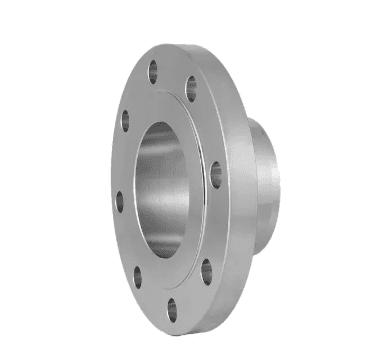
The hub thickness tapers from the flange OD toward the weld bevel, spreading stress away from the face and gasket.
The flange bore is machined to the pipe inside diameter, which reduces turbulence and erosion at the joint.
A full-penetration butt weld is inspectable (RT/UT) and is the preferred joint for cyclic, high-temperature, and high-pressure service.
Selection
Both are ASME B16.5 flanges. Choose weld neck when the joint sees pressure, temperature, or fatigue. Choose slip-on when fit-up speed and cost matter more than hub strength.
| Feature | Weld neck | Slip-on |
|---|---|---|
| Attachment | Butt weld through a tapered hub | Fillet welds inside and outside the bore |
| Bore | Matches the pipe ID | Larger than the pipe OD so the pipe can slip in |
| Stress path | Carried into the hub | Concentrated at the fillet welds and face |
| Typical service | High pressure, high temperature, cyclic | Low to moderate pressure, easier alignment |
| Inspection | Butt weld can be RT/UT examined | Fillet welds are harder to inspect fully |
Specification
A weld neck flange is a flange with a long tapered hub that is butt-welded to the pipe. The bore matches the pipe, which keeps flow smooth and moves stress into the hub rather than the flange face.
Use a weld neck for high pressure, high temperature, vibration, or cyclic service, and whenever the weld must be radiographed. Use a slip-on for lower-pressure lines where alignment speed and cost are the priority.
Dimensions and facing follow ASME B16.5 for NPS 1/2 through 24. Stainless forgings are typically ASTM A182. JNDIA supplies Class 150 and Class 300 in 304L and 316L.